
The Origin of Magnetism From Atomic Structure to Extreme Magnetic Fields
Magnetism is not a macroscopic accident—it originates deep within the atomic structure of matter. Inside atoms and crystalline solids, both electrons and atomic nuclei possess intrinsic magnetic properties. The magnetic behavior we observe in everyday materials is the collective result of these microscopic magnetic moments and how they are organized within a material.
Magnetic Sources at the Atomic Level
At the atomic scale, magnetism arises from three fundamental contributions:
1、Electron Spin Magnetic Moment
Electrons are charged particles with an intrinsic property known as spin. This spin generates a magnetic moment and is the dominant source of magnetism in solid materials.
2、Orbital Motion of Electrons
As electrons move around the nucleus, their motion is equivalent to a tiny current loop, producing an additional magnetic field. This orbital contribution combines with electron spin to determine the total magnetic moment of an atom.
3、Nuclear Spin Magnetic Moment
Atomic nuclei also possess spin and an associated magnetic moment. However, because nuclear magnetic moments are much weaker than those of electrons, their contribution to macroscopic magnetism is generally negligible.
While every atom contains these magnetic elements, their macroscopic effect depends entirely on how they interact and align within a material.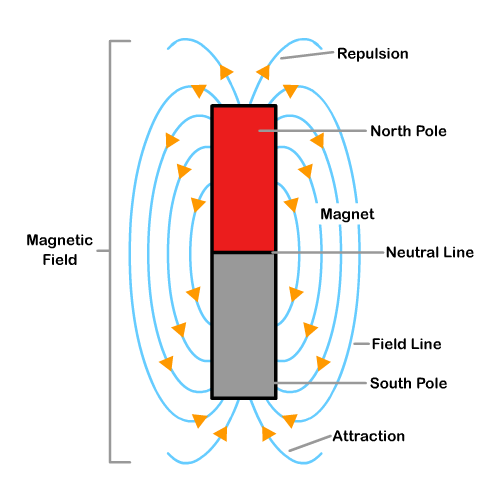
Why Most Materials Are Not Magnetic
In most materials, the magnetic moments of individual atoms are oriented in random directions. As a result, their magnetic fields cancel one another out, and the material exhibits no permanent magnetism. This is true even though the atoms themselves may have nonzero magnetic moments.
Such materials include most metals, non-metals, and compounds, which remain magnetically neutral under normal conditions.
Ferromagnetism: Ordered Magnetic Alignment
In a small class of materials known as ferromagnets, atomic magnetic moments interact through a quantum mechanical exchange interaction that favors parallel alignment. This collective ordering allows magnetic effects to persist at the macroscopic level.
Common ferromagnetic materials include:
•Iron (Fe)
•Cobalt (Co)
•Nickel (Ni)
Within these materials, regions called magnetic domains form, in which millions of atomic spins are aligned in the same direction. When a significant number of domains align, the material becomes a permanent magnet.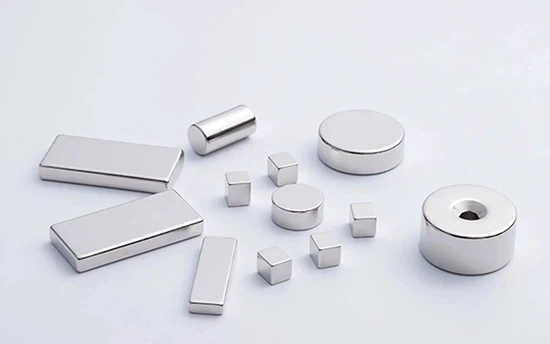
Fundamental Limits of Permanent Magnets
The strength of a permanent magnet is fundamentally limited by the atomic structure of the material and the maximum achievable alignment of electron spins. Even in the strongest permanent magnetic materials, the maximum magnetic field is approximately:
8,000 gauss (0.8 tesla)
This limit reflects the saturation of electron spin alignment and cannot be exceeded by material engineering alone.
Beyond Permanent Magnets: Extreme Magnetic Fields
Magnetic fields far stronger than those of permanent magnets can be generated using electromagnetic techniques. At advanced research facilities such as the Magnet Lab, magnetic fields as high as:
450,000 gauss (45 tesla)
have been achieved—nearly 50 times stronger than the strongest permanent magnets. These extreme fields are produced using powerful electrical currents, often combined with superconducting or pulsed magnet technologies, and are primarily used for scientific research rather than industrial applications.
Conclusion
Magnetism is a clear example of how microscopic quantum properties give rise to macroscopic physical phenomena. The performance limits of permanent magnets are ultimately defined by atomic-scale physics, while extreme magnetic fields require complex and energy-intensive engineering solutions.
Understanding these distinctions is essential for selecting the right magnetic technology—whether for stable, energy-free permanent magnet applications or for cutting-edge research that demands unprecedented magnetic field strengths.
Topping
Contact

We will contact you within 24 hours. ( WhatsApp/facebook:+86 15957855637)