
Neodymium-Iron-Boron (NdFeB) magnets are the cornerstone of modern high-performance engineering. When selecting a magnet for industrial applications, engineers must choose between two fundamentally different manufacturing philosophies: Sintering and Bonding.
While both share the same basic chemical composition (Nd2Fe14B), their mechanical properties, magnetic performance, and geometry capabilities differ significantly. This article provides a professional analysis of the distinctions between sintered and bonded neodymium magnets.
1. Manufacturing Process and Material Structure
The primary difference lies in how the magnetic particles are held together.
Sintered Neodymium Magnets
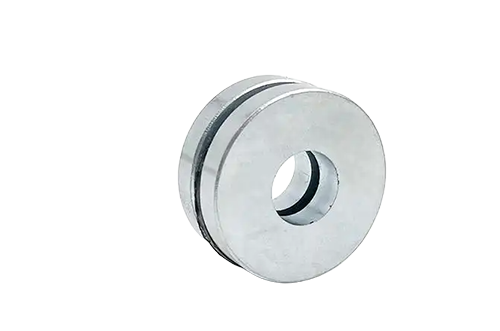
Sintered magnets are produced via powder metallurgy. The raw materials are melted under vacuum, cast into a mold, and cooled to form ingots. These ingots are then pulverized into a fine powder (typically 3-7μm). This powder is compacted in a magnetic field to align the crystals (making the magnet anisotropic) and then "sintered"—heated in a furnace just below its melting point to fuse the particles into a dense, solid metallic block.
Bonded Neodymium Magnets
Bonded magnets are created by mixing NdFeB magnetic powder with a polymer binder, such as epoxy, nylon, or PPS. This compound is then formed into shapes through compression molding or injection molding. Because the magnetic particles are suspended in a non-magnetic resin, the final product is a composite material rather than a pure metallic solid.
2. Magnetic Performance Comparison
The presence of a non-magnetic binder in bonded magnets significantly reduces their magnetic density compared to the fully dense sintered variety.
Magnetic Energy and Remanence
Sintered magnets are the "brute force" powerhouses of the industry. They offer a Maximum Energy Product (BH)max typically ranging from 33 to 55 MGOe. In contrast, bonded magnets generally fall between 6 and 12 MGOe. This means sintered magnets are roughly 4 to 5 times stronger in terms of energy output for the same volume.
Isotropic vs. Anisotropic Properties
Most bonded magnets are isotropic, meaning they have the same magnetic properties in all directions and can be magnetized in any orientation after molding. Sintered magnets are almost always anisotropic, having a "preferred" direction of magnetization established during the pressing process, which allows for much higher flux density in that specific direction.
3. Physical and Mechanical Characteristics
Geometric Complexity and Precision
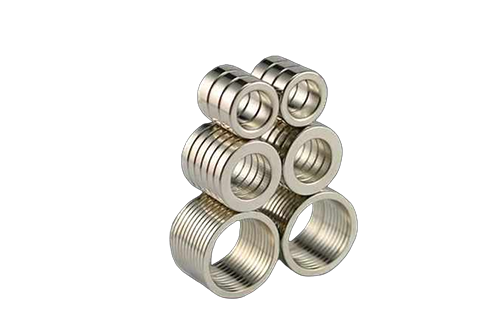
Bonded magnets excel in "Net Shape" manufacturing. Since they use injection molding, they can be formed into incredibly complex geometries, such as thin-walled rings, gears, or magnets molded directly onto shafts. They offer high dimensional tolerance (up to pm ±0.02mm) without the need for secondary machining.
Sintered magnets are typically produced as large blocks or cylinders and must be sliced or ground using diamond-coated tools to achieve the final shape. This limits geometric complexity and increases material waste.
Mechanical Integrity and Brittleness
Sintered NdFeB is a ceramic-like material; it is exceptionally hard but also extremely brittle. It is prone to chipping or cracking under impact or high-speed rotation stress. Bonded magnets are more robust and flexible due to the polymer matrix, providing much higher impact resistance and better structural integrity for high-speed rotors.
Corrosion Resistance
The high iron content in sintered magnets makes them highly susceptible to oxidation. They require protective coatings (such as Nickel, Zinc, or Epoxy) to prevent degradation. In bonded magnets, the individual magnetic grains are encapsulated by the resin binder, providing inherent protection against moisture and corrosion, though a surface seal is often still applied for extreme environments.
4. Key Application Use Cases
Applications for Sintered Magnets
Electric Vehicle (EV) Drivetrains: Where maximum torque and efficiency are required.
Wind Turbines: For high power density in large-scale generators.
MRI Machines: Where stable, ultra-high magnetic fields are critical.
Industrial Servo Motors: For high-precision, high-torque motion control.
Applications for Bonded Magnets
Consumer Electronics: Spindle motors for hard disk drives and haptic motors in smartphones.
Automotive Sensors: ABS sensors, fuel gauges, and precision steering sensors.
Multi-pole Rotors: Applications requiring complex radial or multi-pole magnetization patterns in a single piece.
Home Appliances: Small, efficient motors for vacuum cleaners and cooling fans.
5. Summary of Selection Criteria
Choosing between these two materials requires a trade-off between power and precision. Sintered magnets are the go-to choice when the application demands the highest possible magnetic force and temperature stability. Bonded magnets are the superior choice when the design requires complex shapes, high dimensional accuracy, or a multi-pole magnetic field in a compact, cost-effective package.
Topping
Contact

We will contact you within 24 hours. ( WhatsApp/facebook:+86 15957855637)