
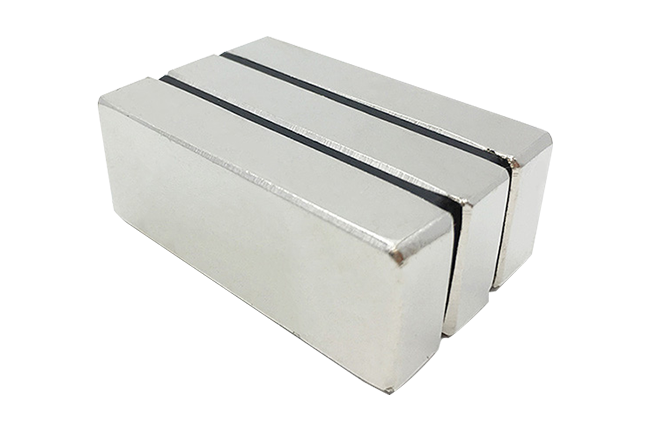
Neodymium Iron Boron (NdFeB) magnets, often simply called NdFeB magnets or Neo magnets, are the strongest type of permanent magnets commercially available. Their exceptional magnetic performance has made them indispensable across countless modern technologies, from tiny smartphone components to powerful wind turbines. But what exactly gives these magnets their incredible strength? The answer lies in their specific, carefully controlled chemical composition.
The Essential Elements of NdFeB
The name "NdFeB" itself gives away the three primary elements that form the bulk of this material: Neodymium (Nd), Iron (Fe), and Boron (B).
1. Neodymium (Nd) - The Powerhouse
Neodymium, a member of the lanthanide series (or rare earth elements), is the key ingredient responsible for the magnet's high coercivity and strong magnetization.
Role: Neodymium atoms possess a very large orbital angular momentum, which contributes significantly to the material's magnetic anisotropy—meaning the atoms' magnetic moments prefer to align along a specific crystallographic axis. This preferential alignment is crucial for creating a strong, stable permanent magnet.
Quantity: In a typical commercial NdFeB magnet alloy, Neodymium is present in quantities ranging from approximately 29% to 32% by weight.
2. Iron (Fe) - The Main Magnetic Carrier
Iron is a foundational element in many magnetic materials, and in NdFeB, it provides the high saturation magnetization.
Role: Iron atoms carry the majority of the magnetic moment in the alloy. Its presence ensures that the magnet can be highly magnetized, resulting in a strong magnetic flux density.
Quantity: Iron makes up the largest proportion of the alloy, typically around 64% to 67% by weight.
3. Boron (B) - The Structural Stabilizer
Boron, a non-metallic element, plays a critical structural role that enables the formation of the desired crystalline phase.
Role: Boron, along with Neodymium and Iron, forms the crucial intermetallic compound Nd₂Fe₁₄B. This unique crystal structure is what gives NdFeB magnets their extraordinary magnetic properties. Without Boron, the stable, highly anisotropic magnetic phase cannot be formed.
Quantity: Boron is present in the smallest proportion, typically around 1% to 1.2% by weight.
The Role of Additives: Enhancing Performance and Stability
While the Nd₂Fe₁₄B phase is the magnetic heart of the material, pure ternary Nd-Fe-B magnets often lack the thermal stability and corrosion resistance required for industrial applications. Therefore, small amounts of other elements are strategically added during the alloying process. These additives are what differentiate various grades of NdFeB magnets.
A. Enhancing Coercivity (High-Temperature Stability)
Dysprosium (Dy) and Terbium (Tb): These are heavier rare-earth elements that are often substituted for a small portion of the Neodymium. They significantly increase the magnet's coercivity (resistance to demagnetization), especially at elevated temperatures. This is vital for applications like electric vehicle motors.
Aluminum (Al): This element can also be added to refine the microstructure and improve the coercivity of the material.
B. Improving Corrosion Resistance
Cobalt (Co): Substituting a small amount of Iron with Cobalt helps improve both the temperature stability and the corrosion resistance of the magnet.
Copper (Cu) and Niobium (Nb): These elements are often used in small amounts to refine the grain boundaries, which helps in processing and can also impact the magnet's resistance to oxidation.
Manufacturing: From Powder to Powerful Magnet
The composition's effectiveness is locked within the magnet's microstructure, which is determined by the manufacturing process. There are two main types of commercial NdFeB magnets, each with a slightly different composition and process:
1. Sintered NdFeB: The primary production method. The alloy is cast, crushed into a fine powder, pressed in a magnetic field (orientation), and then heated (sintered) to form a dense, crystalline structure. This process results in the highest-performance NdFeB magnets.
2. Bonded NdFeB: The NdFeB powder is mixed with a polymer binder (like epoxy or nylon) and then compression or injection molded. These magnets have lower magnetic properties but can be manufactured into complex shapes with high precision.
Conclusion
The remarkable strength of NdFeB magnets is not a coincidence; it is a direct result of the specific, synergistic combination of elements. Neodymium provides the anisotropy, Iron delivers the bulk magnetization, and Boron forms the essential crystal structure Nd₂Fe₁₄B. Further additions of elements like Dysprosium and Cobalt tune the magnet's properties for demanding applications, solidifying the NdFeB magnet's place as a fundamental component in the technological landscape of the 21st century.
Topping
Contact

We will contact you within 24 hours. ( WhatsApp/facebook:+86 15957855637)